
Many shops, one central SMS account: how it works, with an example
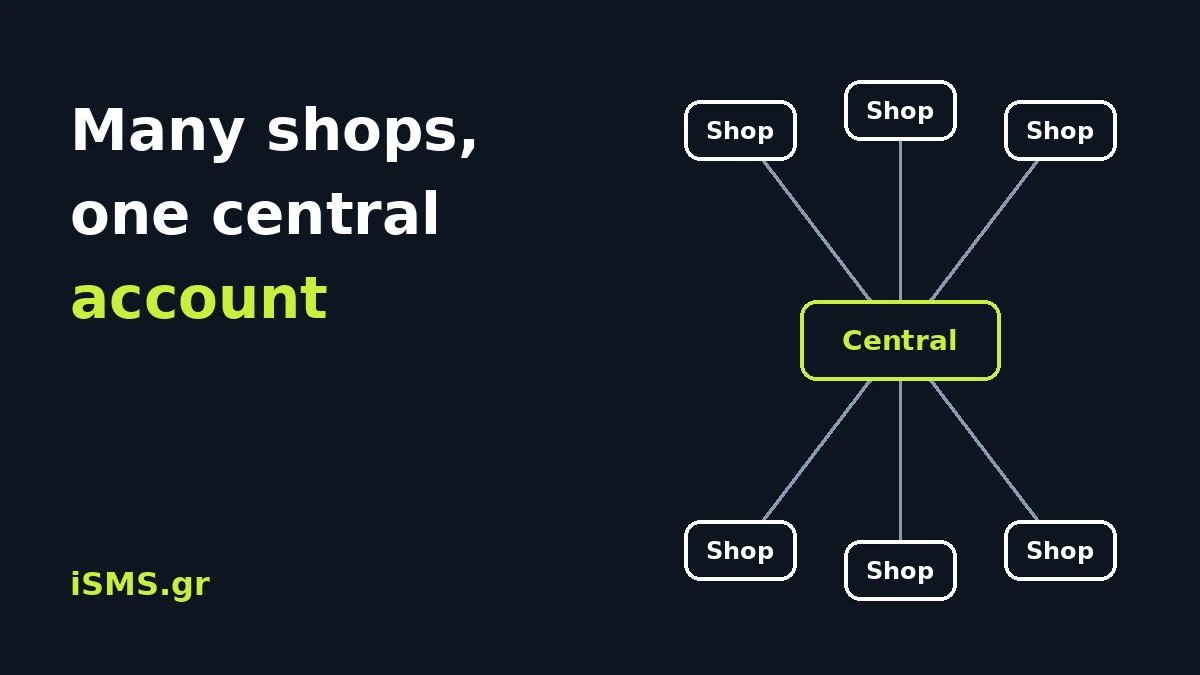
When a business has many shops, SMS becomes an organisational problem before it becomes a technical one. One account for everybody means one shop can spend the balance of the others. A separate account for each, with no link, means head office does not know who has units left and who has run out. Linked accounts at iSMS.gr sit between the two.
An example
Picture a company that franchises coffee and pastry shops and has 12 shops in different cities. The name is made up; call it "Café Melina".
Each shop wants to send its own messages: "Your order is ready", an offer for Friday, a birthday greeting. Head office wants three things:
- to buy units once and share them out to the shops,
- to see which shop has a balance and which does not,
- to make sure a shop cannot send more than its share.
With linked accounts it looks like this:
- Head office has a central account. We switch the feature on for it, on request.
- Every shop has its own account with its own balance, its own contacts, its own sender name and, if needed, its own API key.
- Head office buys units and transfers them to the shops when needed, for example 5,000 to the Thessaloniki shop before a campaign.
- Head office sees each shop's balance. Only that: not the messages, not the history, not the contacts.
- When a shop reaches zero, its send is refused before it is queued. It never touches anybody else's balance.
How a shop is linked
The link uses a code, so nobody can be linked without knowing it:
- The shop creates a one-time link code in its own account, valid for 24 hours.
- The central account enters it and confirms the link.
- From then on the shop appears in the central account's list, with its balance.
The link can be ended by the shop, the central account or our administrator. See all the steps and screens on the page Linked accounts.
What applies to each shop
- It is an ordinary customer. It accepts the iSMS.gr Terms and is responsible for its own messages. Recipient consent and contacts do not pass through head office.
- It has its own sender. The name the recipient sees can be "Melina Thess" and need not be the same for all. In countries that ask for approval, each sender is approved separately. See the article about Sender ID.
- A breach does not affect the other shops. If one account is locked, only that one is locked.
- Units move in one direction. Head office gives and never pulls a balance back. If a shop closes and wants to return units, it sends them to head office itself.
- A shop's account is not created through the API. The shop opens it, or our administrator does.
Who else uses it
The example fits any "one centre and many senders" structure:
- Franchise networks (coffee shops, bakeries, hair salons, tutoring centres, gyms) with a central brand and independent owners.
- Groups of companies with a separate company per shop or activity, who want to buy together and use separately.
- Software companies and platforms (e-shops, booking, CRM) that give each of their customers SMS with its own limit and API key. If the integration is through the API, see also the page Bulk SMS API and SMPP.
- Accounting firms and consultancies that send on behalf of many clients and want to keep them apart.
How to start
Contact us and tell us how many shops you have and how they send today. We switch the feature on for your central account and the rest is done in the panel.